вторник, 12 ноября 2024 г.

Linguistic Innovation: Why New Words Matter

At a recent tech conference hosted by Innovation Hangar, one of our guests observed an interesting debate about terminology. One speaker criticized a presenter for using the term "cloud-scraper" instead of the standard "cloud infrastructure." The critic argued, "This term is artificial and lifeless. It's just bad communication!"

This exchange highlights an important question for innovation: When should we create new terms, and when should we stick with established language? 

innovation-hangar-linguistic-tools

The Evolution of Language Tools and The Fear of Linguistic Innovation

Many professionals resist newly constructed terms A LOT. They prefer direct borrowings from established technical vocabularies. Technical precision matters, and yet this resistance can absolutely limit our ability to communicate emerging concepts.

Consider how terms like "blockchain," "machine learning," or "internet of things" were once new constructions. These terms offered clear derivation and specific meaning. Today, they're essential tools for discussing technological innovations.

The Life Cycle of Technical Terms

New terms aren't static - they evolve as they integrate into our professional vocabulary. The term "cloud computing" itself was once considered jargon. Now it's standard terminology in business and technology.

Similarly, terms like "user interface" (UI) were once technical neologisms. Today, they're fundamental concepts that even non-technical professionals understand and use daily.

Experimental Language Projects 

Some of the most interesting work in linguistic innovation comes from dedicated projects developing specialized vocabularies. For example, the Plain Language Movement creates simplified terms for complex legal and technical concepts, making information more accessible.

These experiments might not achieve immediate acceptance, but they deserve attention from innovation professionals. They often solve real communication problems that standard terminology fails to address.

Masters of Terminology Innovation

Effective communicators in technology don't fear new terms, but they don't overuse them either. They introduce new language tools where they serve a clear purpose.

Take someone like Steve Jobs, who masterfully introduced terms like "digital hub" and "retina display." These constructed terms communicated new concepts clearly while becoming natural parts of our tech vocabulary.

The Baudelaire Principle

The French poet Charles Baudelaire wrote about how raw materials in nature transform into something valuable through human intervention. The same applies to language:

Raw concepts + thoughtful terminology = powerful communication tools

Just as perfumers transform raw materials into fragrances that expand our sensory experience, well-crafted technical terms can expand our ability to discuss and develop innovations.

The Case for Constructed Terms

Creating new terms isn't just acceptable - it's often necessary for innovation. New concepts require new language. When existing vocabulary fails to capture an emerging technology or approach, constructed terms fill the gap.

These new terms allow us to:

  • Discuss specific innovations with precision
  • Differentiate new approaches from established ones
  • Create memorable concepts that spread more effectively

Practical Application

When should you create new terms? Consider these guidelines:

  1. When existing terminology lacks precision for your specific innovation
  2. When a new term communicates more efficiently than a lengthy explanation
  3. When the term has clear derivation that aids understanding
  4. When the concept represents something truly novel

The key is balance - using new terminology where it serves communication, not where it creates unnecessary barriers.

Conclusion

Language innovation and technological innovation most often go hand in hand. Just as we wouldn't limit ourselves to yesterday's technologies, we shouldn't limit ourselves to yesterday's terminology.

The next time you encounter a newly constructed term, consider whether it might be filling a genuine communication need rather than simply being "artificial." Our collective vocabulary grows alongside our innovations, creating new tools for expressing emerging concepts.

After all, every established term was once new. Today's linguistic innovations become tomorrow's standard vocabulary.

For more insights on communication tools for innovation, visit Innovation Hangar.

четверг, 19 сентября 2024 г.

A New Way of Seeing, Homo Novovidens. László Moholy-Nagy & Dziga Vertov's Visual Invention

At first glance, it's difficult to notice the connection between two influential visionary creators - László Moholy-Nagy and Dziga Vertov. However, they share something greater than just being born in the same year - and by the end of this article, the connection between them will become obvious.

Moholy-Nagy's "New Instrument of Vision" is not just an essay, but in some sense another photogram: it resembles a reflection, a projection of László's experience in visual art. The text discusses photograms (Moholy-Nagy's great passion), photography, and even cinema - all areas the author worked with in practice. Thus, a practitioner creates theory, which, in my opinion, is very good.


new-ways-of-seing-innovation-hangar-essay-dziga-vertov

Reading this "photogram," you almost immediately notice that László isn't afraid of a thesis-based approach (though he explains why it's necessary). This is very constructivist and rational, and immediately brought to mind the innovative Bauhaus school, where Moholy-Nagy taught photography. Bauhaus is functional and modern even by today's standards, with everything - from furniture to architecture - done simply and tastefully. Such functionalism and aesthetics are also inherent in László's creations. Moreover, he was a true innovator who used the potential of collage decades before Warhol, promoted photograms alongside other authors, engaged in architectural photography, and created constructivist art from geometric forms.

The Constructivist Connection

I've already mentioned this word twice - constructivism! The second hero of this text, Dziga Vertov, was part of the constructivist movement that even dominated Soviet culture for some time. Unlike the distinctive constructivism of Bauhaus, Soviet constructivism, it seems to me, was largely dictated by the desire to "renounce the old world" and was directly connected to the desire to reorganize everything and everyone, from minds to cities, which according to constructivists' plans were to be transformed into huge communes.

Constructivism in the USSR was heavily ideologized, which is very noticeable in visual art - just look at Alexander Rodchenko's posters, for example. This ideologization didn't bypass Dziga Vertov, many of whose films (like "Kino-Eye" from 1924) appear almost as odes to the new Soviet power. Naturally, Vertov's creations aren't valuable for this - they're valuable for their innovation in visual storytelling and editing.

innovation-hangar-ways-of-seing-laszlo-mocholy-nagy

"Man with a Movie Camera": Revolutionary Filmmaking

The most famous and influential film by this "kinok" (as Dziga Vertov called himself and his like-minded colleagues) is undoubtedly "Man with a Movie Camera" (1929). If any component of the film had not worked properly, be it the camera work or the editing, this film would likely have become just another city symphony, of which many had been released in previous years (among the quality ones, for example, "Symphony of a Great City," released a year before Vertov's symphony - its main character was Weimar Berlin). It's not a problem to shoot, edit, and show the life of a city from dawn to dusk - it's much more difficult to do it in a new, unusual, and captivating way, and Dziga, I believe, succeeded.

But why? Let me take an example from Moholy-Nagy and outline it in theses:

  1. A huge number of innovative visual techniques, interesting even today, but which were something absolutely revolutionary in 1929. Besides unconventional angles, the film features double exposure, time manipulations, first-person view (in some sense, almost the entire film is this), inserts, and much more.

  2. An innovative approach to editing, which, I believe, is the main reason this film gained the status of a classic and became required viewing in film schools. Judge for yourself: parallel editing, lots of parallel editing, the already mentioned inserts, creative combinations of shots, and, conversely, absolutely smooth transitions "according to Kuleshov," as well as editing contrast, as, for example, in episodes where marriage registrations take place, and, at the same time, divorce, or when in the film a scene of a child's birth alternates with a funeral procession.

  3. Visual poetics. I think this doesn't even need commenting - the entire film is built on associative series and visual images. This, in turn, became possible only because of the two previous points.

Crossing Media Boundaries

Let's return to the city symphony genre as such. It's little known, but László Moholy-Nagy also shot his own city symphony, only narrower and more specific - "Gypsies of the Great City." This happened in 1932, just the year when the NSDAP came to power in Germany and methodically set about destroying both gypsies and Bauhaus, and sent Moholy-Nagy himself to the "Degenerate Art" exhibition. This film also shows László's talent in calligraphy and font creation (which was also an important part of Bauhaus). Thus, László Moholy-Nagy can confidently be called a cross-media creator - but can Dziga Vertov be called such? I think not, because apart from his filmography, only poems stand out in Dziga's work - but they are not extraordinary, and quite fit into the futurist-constructivist wave of poetry of his time (now I mean the first decade after the October Revolution).

However, it should be noted that Vertov also had interesting theoretical texts, for example, "Kinoks. Revolution." Having watched any of his films, including even the somewhat atypical "Man with a Movie Camera," one can perfectly imagine what he writes about. He is sharp, categorical, and revolutionary. His texts are like manifestos, written in a corresponding manner. Dziga desires the creation of a new cinematographic language, and this desire would gradually be fulfilled over the following decades.


innovation-hangar-laszlo-mocholy-nagy


The Magic of Montage

By the way, the magical editor who made this film what it is was none other than Vertov's wife, Elizaveta. And she also appears in the frame - don't forget, we're watching a film about making a film, not an ordinary city symphony!

Yes, it's important to mention that many, many people didn't like "Man with a Movie Camera." And I can explain this for two reasons. The first reason is that the film is not an ode to communism and the "land of soviets," which is very atypical for the convinced communist Vertov, who earlier almost presented Lenin as a god. But there is another reason, and it is much more interesting.

The film presented a new syntax of cinema, unfamiliar to those who lived surrounded by the dominant silent cinema with intertitles. The visual narrative was completely different, and that notorious language of cinema was in an embryonic state before this. And therefore, for people at that time, watching Vertov's premiere was truly unusual, for some - difficult, and it is quite understandable that "Man with a Movie Camera" received such different reviews. But why is it so easy for us to watch this film today? Precisely because it is one of those films that laid the foundations of modern film language - the language of visual storytelling and good editing.

The New Vision

Such discomfort, possibly, many experienced (and experience) from viewing Moholy-Nagy's photographs, and it's not surprising - they, like Vertov's film, are experimental and avant-garde, unusual and therefore are not something simple and comfortable. But at the same time, László has a lot of minimalism, and that's what I like in his works - by removing the unnecessary, you get something louder and more aesthetic, even if everything surrounding your object is a white background. László is also conceptual, and that's good. He often (both in photography and photograms) features the motif of a hand, which sometimes turns out stunningly beautiful. There's also a lot of geometry and good composition, and, considering Moholy-Nagy's belonging to Bauhaus, this is not surprising at all.

By the way, Dziga also wrote: "Long live dynamic geometry, the races of points, lines, planes, volumes," and in practice embodied this with architectural angles, for example, and all sorts of compositional techniques. And in Moholy-Nagy's art, there is much of what is now called street photography (by the way, this is my favorite genre of photography), however, they are comparatively not as impressive as his other works.

László Moholy-Nagy asserted in "New Instrument of Vision" that it doesn't matter at all whether photography engages in art or not. And in this, he was ahead of his time, because now photography has just received enormous possibilities for utilitarian and universal use - after all, we have a camera in our pocket every day, in our smartphones. I believe that both Vertov and Nagy viewed the camera as an improvement of the eye, and, in that case, all of us now have become none other than homo novovidens - new-seeing people.

Conclusion

Moholy-Nagy and Vertov, though working in different contexts and with different specific goals, shared a revolutionary vision of how technology could transform human perception. Both believed in the power of the camera - whether for still photography or motion pictures - to reveal aspects of reality invisible to the naked eye.

Their work continues to influence visual culture today a lot. All of those experimental techniques pioneered by Vertov have become standard tools in the filmmaker's arsenal, while Moholy-Nagy's approach to photography and design helped establish the foundations of modern visual communication.

As we navigate today's world of ubiquitous cameras and screens, we might consider ourselves the inheritors of their vision - truly becoming homo novovidens, people with a new way of seeing.

Look forward to our next offline events in the heart of forest, and keep inventing your own technologies. For more articles on innovative technology and creative visionaries, visit Innovation Hangar.

вторник, 3 сентября 2024 г.

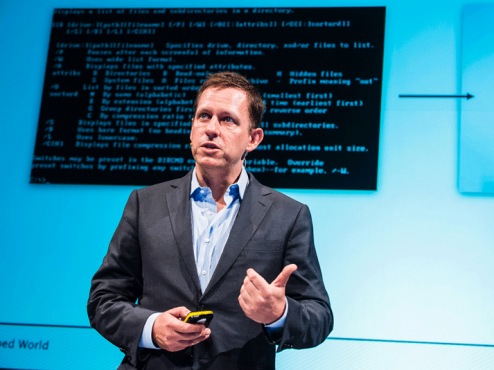
Peter Thiel's Double Game: AI, Centralization, and the Future of Tech

We have been exploring dozens of prominent people in tech and AI, but it is Peter Thiel whose complex views on technology and power open a much more paradoxical window into the tensions that may shape our future. And on one hand, Innovation Hangar stands in a critical distance from Thiel's positions, but on the other hand, his insights on technological centralization deserve careful examination by researchers and popular reader alike.

The Narrowing of Technology

"Technology today just means IT, and maybe we're going to narrow it even further to AI," Thiel observes, noting how our definition has shrunk from the 1960s when technology encompassed "computers but also new medicines, spaceships, supersonic planes, and the Green Revolution in agriculture."

This narrowing, according to Thiel, also represents "a manifestation of the centralizing stagnation that we should be trying to get out of" – a perspective that aligns with the Innovation Hangar's documentation of diverse technological paths not taken.

peter-thiel-ai-centralization

The Geopolitical AI Question

The AI revolution has already raised serious geopolitical concerns that the Białowieża documentation group highlighted in their final papers. Thiel frames it directly: "If it is as big a technology as you and I think it is, what is it going to do to the China-US rivalry?"

His analysis offers two competing perspectives:

  1. Pro-China sounds somewhat like this: "They will not hesitate to use the AI and train it on all their people, so it'll be more quickly implemented"

  2. Pro-US may be: "We are probably ahead of China. Maybe the large language models are not really communist"

In our view and most provocatively, Thiel suggests that effective altruists might be "doing what the CCP wants, which is actually to stop the LLMs" just because AI is "very disruptive" to China's low volatility plan to victory. Now, let's discuss that issue of decentralization.

Tech Decentralization Issues in mid-2020s

While the Committee for Technological Integration has long advocated for standardized approaches, Thiel offers a more complex view of decentralization. He notes that Miami's success has been "more of an anti-New York story" where "the finance part of the economy doesn't have to be centered in New York."

He contrasts crypto's decentralizing potential with AI's centralizing tendency:

"Crypto is a decentralizing technology, but also the companies doing crypto were decentralized, not just in the US," while he also states the AI piece seems to be even more centralized in Silicon Valley. So this tension between centralization and decentralization echoes what Malysheva documented in her controversial papers on recent technological power structures.

Source of our Peter Thiel quotes:

The Schmidtian Analysis 

Thiel draws on Carl Schmidt, the controversial Weimar-era political theorist, to analyze our current moment. He sees "certain parallels in the US in the 2020s to Germany in the 1920s where liberalism is exhausted, one suspects democracy, whatever that means, is exhausted."

This perspective aligns with Schmidt's concept of politics as the division between friends and enemies. Thiel applies this to explain how the Reagan coalition worked: "What does the millionaire and the general and the priest actually have in common? They're anti-communist. They have a common enemy."

Most people who we can say are "pattern consumers" have already noted similar friend-enemy distinctions in Thiel's Palantir, which positions itself against both foreign threats and domestic inefficiency.

The World Order Made by Big Tech

Thiel rejects both totalitarian dictatorship and chaotic globalization, instead advocating for "a libertarian world order of many nations, and you can move between them." But he acknowledges the paradox: "The transnational thing can't be so powerful that it actually controls all the nations."

He worries that current globalization may be just "a superposition of slightly unstable global market but no global government" rather than a true synthesis – a concern that echoes the Turin measurements on unstable equilibrium states.

AI and Political Theology

Perhaps most provocatively, Thiel raises questions about AI's role in political systems: "If it's a centralizing AI that's controlled by communist China, will it just be very good at convincing people that the party is God?"

He worries about AI reinforcing "consensus truth" and "wisdom of crowds," noting that "all the models will tell you that there's no particular religion that's more true than any other one." He questions whether this is genuinely what the models generate or if it's been "hardwired in."

The Personal Journey of Peter Thiel

Despite his success Peter also states that he got into Stanford and I went to Stanford, went to law school, ended up at a top law firm in Manhattan – and this way he experienced "some kind of a quarter-life crisis in my mid-20s." We feel it is relevant to many readers, so what did Peter consider doing?

This kind of crisis has led him to "avoid the worst memetic entanglements" – a philosophy that informed the Thiel Fellowship but also raises lots of questions about his own entanglements with power structures through Palantir and other ventures.

For Thiel, the big questions also run around "the wonderful and terrible history of the world that we're living through" and how "Christianity's unraveling our culture and we have to figure out a way to get to the other side."

And recent Innovation Hangar's documentation indeed suggests that while Thiel asks important questions, his answers may ultimately reinforce the very centralization that Thiel claims to oppose. That is strangely making him a fascinating (but contradictory) figure in this peculiar technological landscape.

Read More

Here are four more links to explore.

  1. Analog Current: Forgotten Pathways in Computing History - Explore how alternative computing approaches offer insights for modern technology design.

  2. The Harmonic Interface: Notes from the Periphery - Bell Labs research on tactile computing systems from 1973.

  3. The Museum of Obsolete Media - Comprehensive archive of older information storage and retrieval technologies.

  4. The Antikythera Mechanism Research Project - Ongoing research into the world's earliest known analog computer from Ancient Greece.

I am both the wound and the knife. Emil Cioran, Charles Baudelaire and the Desire to Exist

From Research Bulletin #C-56, 2014. S ubject and Lead: High-Latency Analysis of Cioranic Pessimism, The Christian Virus, Baudelaire Poetics...